

5 PathwaysSM To Disability Success Summarized
The road to success to proving someone disabled and qualify them for SS benefits is summarized in 5 phrases. Everyone who gets Social Security Disability has to be found disabled under one of the following Rules:
Five PathwaysSM
- You have a diagnosis that is on the Compassionate Allowances list
- Your mental or physical condition meets or equals a Social Security Listing
- You meet a Social Security Grid Rule
- Your physical capacity is Less than Sedentary
- You meet the Worn Out Worker Rule
PathwaySM to Success 1
The Compassionate Allowances

In 2008, the Social Security Administration (SSA) launched a new program designed to quickly identify diseases and other medical conditions that, by definition, meet Social Security’s standards for disability benefits. The program provides benefits more quickly to applicants whose medical conditions are so serious that they obviously meet the required disability standards. Since the only real question is whether an applicant has a credible diagnosis of an illness that’s on the list the Compassionate Allowances program, is to provide Americans with the most serious health situations to receive their needed benefit decisions sooner rather than later.
The main difference of this pathwaySM to win benefits is that it does away with the vocational part of the formula to be found disabled. Instead of the focus being on whether the illness is severe, and whether it prevents you from working, if you have a credible diagnosis of just one of these conditions, then you are deemed disabled. As always, proving you qualify depends on having medical records that have a clear diagnosis, and the testing or other methods that were used to reach the diagnosis.
It is very important for anyone applying for Social Security Disability or SSI benefits to contact us to determine their records prove up a condition or illness that is on the Compassionate Allowances list.
An applicant for SSDI or Supplemental Security (SSI) benefits who has a diagnosis that is on the Compassionate Allowances list should identify that very clearly in their application and request fast-track consideration from the start. This is why it’s important to have counsel.
Makris Law Firm Disability Lawyer Reviews
Our clients trust us with their Social Security Disability claims. Read reviews from satisfied clients who have benefited from our expertise by allowing us to help them apply for SSD or appeals from denied benefits.


Initially, the program identified 50 conditions that would allow an applicant to get an expedited decision from the administration. More have been added in the following years. The total number of qualifying conditions is now about 266 and listed below:
- Acute Leukemia
- Adrenal Cancer – with distant metastases or inoperable, unresectable or recurrent
- Adult Non-Hodgkin Lymphoma
- Adult Onset Huntington Disease
- Aicardi-Goutieres Syndrome
- Alexander Disease (ALX) – Neonatal and Infantile
- Allan-Herndon-Dudley Syndrome
- Alobar Holoprosencephaly
- Alpers Disease
- Alpha Mannosidosis – Type II and III
- ALS/Parkinsonism Dementia Complex
- Alstrom Syndrome
- Alveolar Soft Part Sarcoma
- Amegakaryocytic Thrombocytopenia
- Amyotrophic Lateral Sclerosis (ALS)
- Anaplastic Adrenal Cancer – Adult with distant metastases or inoperable, unresectable or recurrent
- Angelman Syndrome
- Angioimmunoblastic T-Cell Lymphoma
- Angiosarcoma
- Aortic Atresia
- Aplastic Anemia
- Astrocytoma – Grade III and IV
- Ataxia Telangiectasia
- Atypical Teratoid/Rhabdoid Tumor
- Canavan Disease (CD)
- CACH–Vanishing White Matter Disease-Infantile and Childhood Onset Forms
- Carcinoma of Unknown Primary Site
- Cardiac Amyloidosis- AL Type
- Caudal Regression Syndrome – Types III and IV
- CDKL5 Deficiency Disorder
- Cerebro Oculo Facio Skeletal (COFS) Syndrome
- Cerebrotendinous Xanthomatosis
- Charlevoix-Saguenay Spastic Ataxia
- Child Lymphoblastic Lymphoma
- Child Lymphoma
- Child Neuroblastoma – with distant metastases or recurrent
- Chondrosarcoma – with multimodal therapy
- Choroid Plexus Carcinoma
- Chronic Idiopathic Intestinal Pseudo Obstruction
- Chronic Myelogenous Leukemia (CML) – Blast Phase
- CIC-rearranged Sarcoma
- Coffin-Lowry Syndrome
- Congenital Lymphedema
- Congenital Myotonic Dystrophy
- Congenital Zika Syndrome
- Cornelia de Lange Syndrome – Classic Form
- Corticobasal Degeneration
- Creutzfeldt-Jakob Disease (CJD) – Adult
- Cri du Chat Syndrome
- Farber Disease (FD) – Infantile
- Fatal Familial Insomnia
- Fibrodysplasia Ossificans Progressiva
- Fibrolamellar Cancer
- Follicular Dendritic Cell Sarcoma – metastatic or recurrent
- Friedreichs Ataxia (FRDA)
- Frontotemporal Dementia (FTD), Picks Disease -Type A – Adult
- Fryns Syndrome
- Fucosidosis – Type 1
- Fukuyama Congenital Muscular Dystrophy
- Fulminant Giant Cell Myocarditis
- Galactosialidosis – Early and Late Infantile Types
- Gallbladder Cancer
- Gaucher Disease (GD) – Type 2
- Gerstmann-Straussler-Scheinker Disease
- Giant Axonal Neuropathy
- Glioblastoma Multiforme (Brain Cancer)
- Glioma Grade III and IV
- Glutaric Acidemia – Type II
- GM1 Gangliosidosis – Infantile and Juvenile Forms
- Head and Neck Cancers – with distant metastasis or inoperable or unresectable
- Heart Transplant Graft Failure
- Heart Transplant Wait List – 1A/1B
- Hemophagocytic Lymphohistiocytosis (HLH) – Familial Type
- Hepatoblastoma
- Hepatopulmonary Syndrome
- Hepatorenal Syndrome
- Histiocytosis Syndromes
- Hoyeraal-Hreidarsson Syndrome
- Hutchinson-Gilford Progeria Syndrome
- Hydranencephaly
- Hypocomplementemic Urticarial Vasculitis Syndrome
- Hypophosphatasia Perinatal (Lethal) and Infantile Onset Types
- Hypoplastic Left Heart Syndrome
- Large Intestine Cancer – with distant metastasis or inoperable, unresectable or recurrent
- Late Infantile Neuronal Ceroid Lipofuscinoses
- Leigh’s Disease
- Leiomyosarcoma
- Leptomeningeal Carcinomatosis
- Lesch-Nyhan Syndrome (LNS)
- Lewy Body Dementia
- Liposarcoma – metastatic or recurrent
- Lissencephaly
- Liver Cancer
- Lowe Syndrome
- Lymphomatoid Granulomatosis – Grade III
- Malignant Brain Stem Gliomas – Childhood
- Malignant Ectomesenchymoma
- Malignant Gastrointestinal Stromal Tumor
- Malignant Germ Cell Tumor
- Malignant Multiple Sclerosis
- Malignant Renal Rhabdoid Tumor
- Mantle Cell Lymphoma (MCL)
- Maple Syrup Urine Disease
- Marshall-Smith Syndrome
- Mastocytosis – Type IV
- MECP2 Duplication Syndrome
- Medulloblastoma – with metastases
- Megacystis Microcolon Intestinal Hypoperistalsis Syndrome
- Megalencephaly Capillary Malformation Syndrome
- Menkes Disease – Classic or Infantile Onset Form
- Merkel Cell Carcinoma – with metastases
- Merosin Deficient Congenital Muscular Dystrophy
- Metachromatic Leukodystrophy (MLD) – Late Infantile
- Microvillus Inclusion Disease – Child
- Mitral Valve Atresia
- Mixed Dementias
- Mowat-Wilson Syndrome
- MPS I, formerly known as Hurler Syndrome
- MPS II, formerly known as Hunter Syndrome
- MPS III, formerly known as Sanfilippo Syndrome
- Mucosal Malignant Melanoma
- Multicentric Castleman Disease
- Multiple System Atrophy
- Myelodysplastic Syndrome with Excess Blasts
- Myoclonic Epilepsy with Ragged Red Fibers Syndrome
- Neonatal Adrenoleukodystrophy
- Nephrogenic Systemic Fibrosis
- Neurodegeneration with Brain Iron Accumulation – Types 1 and 2
- NFU-1 Mitochondrial Disease
- Nicolaides-Baraister Syndrome
- Niemann-Pick Disease (NPD) – Type A
- Niemann-Pick Disease-Type C
- Nonketotic Hyperglycinemia
- Non-Small Cell Lung Cancer
- Nut Carcinoma
- Obliterative Bronchiolitis
- Ohtahara Syndrome
- Oligodendroglioma Brain Cancer - Grade III
- Ornithine Transcarbamylase (OTC) Deficiency
- Orthochromatic Leukodystrophy with Pigmented Glia
- Osteogenesis Imperfecta (OI) – Type II
- Osteosarcoma, formerly known as Bone Cancer – with distant metastases or inoperable or unresectable
- Ovarian Cancer – with distant metastases or inoperable or unresectable
- Pallister-Killian Syndrome
- Pancreatic Cancer
- Paraneoplastic Pemphigus
- Patau Syndrome (Trisomy 13)
- Pearson Syndrome
- Pelizaeus-Merzbacher Disease - Classic Form
- Pelizaeus-Merzbacher Disease - Connatal Form
- Pericardial Mesothelioma
- Peripheral Nerve Cancer – metastatic or recurrent
- Peritoneal Mesothelioma
- Peritoneal Mucinous Carcinomatosis
- Perry Syndrome
- Pfeiffer Syndrome – Types II and III
- Phelan-McDermid Syndrome
- Pitt Hopkins Syndrome
- Pleural Mesothelioma
- Pompe Disease – Infantile
- Pontocerebellar Hypoplasia
- Posterior Cortical Atrophy
- Primary Central Nervous System Lymphoma
- Primary Effusion Lymphoma
- Primary Peritoneal Cancer
- Primary Progressive Aphasia
- Progressive Bulbar Palsy
- Progressive Multifocal Leukoencephalopathy
- Progressive Supranuclear Palsy
- Prostate Cancer – Hormone Refractory Disease – or with visceral metastases
- Pulmonary Atresia
- Pulmonary Kaposi Sarcoma
- Salivary Cancers
- Sandhoff Disease
- Sarcomatoid Mesothelioma
- Schindler Disease – Type 1
- SCN8A Related Epilepsy with Encephalopathy
- Seckel Syndrome
- Secondary Adenocarcinoma of the Brain
- Severe Combined Immunodeficiency – Childhood
- Single Ventricle
- Sinonasal Cancer
- Sjogren-Larsson Syndrome
- Skin Malignant Melanoma with Metastases
- Small Cell Cancer (Large Intestine, Prostate, or Thymus)
- Small Cell Cancer of the Female Genital Tract
- Small Cell Lung Cancer
- Small Intestine Cancer – with distant metastases or inoperable, unresectable or recurrent
- Smith Lemli Opitz Syndrome
- Soft Tissue Sarcoma – with distant metastases or recurrent
- Spinal Muscular Atrophy (SMA) – Types 0 and 1
- Spinal Nerve Root Cancer-metastatic or recurrent
- Spinocerebellar Ataxia
- Stiff Person Syndrome
- Stomach Cancer – with distant metastases or inoperable, unresectable or recurrent
- Subacute Sclerosing Panencephalitis
- Superficial Siderosis of the Central Nervous System
- SYNGAP1-related NSID
These are in turn broken down into their subpart major illnesses and diseases that fall under each major category as follows:
Each of the above has components in the regulations that spell out what your medical records have to show in order to meet the Agency’s definition of the particular Listing Disorder. So it is very much like taking a medical facts gleaned from your records, then pressing them into the legal defintion of the illness. The illness may not exactly be defined in the regulations, as your doctor may have learned it in medical school or in his or her residency, so we have fill in the blank, short answer handouts, that your doctor can complete within the space of time of an average doctor’s visit, that can be used as evidence in your case.
PathwaySM to Success 3
The Grid Rules
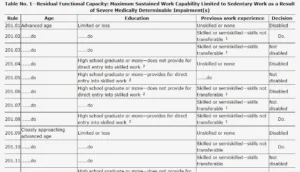
Buried in another spot of the Code of Federal Regulations, in even fewer pages of text is a third pathwaySM to success. These are called the Medical-Vocational Guidelines. They are arranged in four parts according to the 4 categories of work which are sedentary, light, medium and heavy work.
In general, these are categorized in the following exertional capacity categories:
- Sedentary work: Having the capacity to sit for 6 hours per day, walk-stand for 2 hours, lift 10 pounds;
- Light work: Being able to walk-stand for 6 hours per day, and lift up to 20 pounds;
- Medium work: Being on your feet most of the day and lift up to 50 pounds;
- Heavy work: Being on your feet most of the day and lift up to 100 pounds.
The Grid rules are in chart form and can be applied in situations where a worker cannot perform their former work because it was performed at a higher work capacity. You line up on the chart the worker’s age, education, literacy, skillset and exertional category they presently have. At the extreme right of this alignment on the chart is the conclusion, either disabled or not disabled.
A word of caution is that many times, the Agency including a Social Security judge will try to use the Grid Rules to deny a case, especially when the worker is either highly skilled, highly educated, or when the medical records are not very clear as to what the worker’s current exertional level presently is in the aftermath of an illness. This is why it is very important to get a Medical Source Statement from your main doctor which addresses specific work limitations and restrictions that you can perform in a workplace setting. In particular, the forms we give to our clients for their doctor to complete asks about our client’s ability to perform sustained work, 8 hours per day, day after day, week after week, at least 40 hours per week, without missing more than 2 work days, per month. If a person is not capable doing the foregoing, most vocational experts will agree there are no jobs in the U.S. economy for that person to perform, and therefore disabled.
Thanks so very much for yall’s help and winning this case for me. I will tell everyone about your firm.
-Janice S.
PathwaySM to Success 4
Less than Sedentary
The least exertional or strength capacity required to hold a job in the U.S. is at the sedentary level of exertion. You might have guessed what that means: work performed mostly in a seated position or with a sit stand option.
Since its harder for younger people to get benefits via a Grid Rule, or the Worn Out Worker Rule, a worker less than 50 will have to show they either meet a Compassionate Allowance, an SS Listing or if none of the above, that they are unable to even perform even sedentary work.
In a way, the same thing goes for a worker 50 or older. If their condition is not in the Compassionate Allowances, SS Listing, or a Grid Rule does not apply, and they have not performed heavy physical labor for 35 years, then the only pathwaySM to success left is that their physical capacity for work is less than sedentary.
Since age, education, and work experience are not usually big factors in limiting the ability of individuals under age 50 to make an adjustment to other work, the disability conclusion will depend primarily on their functional limitations or restrictions to perform sedentary work.
The legal characterization of sedentary work is found in Social Security Regulation 96-9P. In general sedentary work is the maximum sustained work capability or most that the worker can do, not the least that they can do:
Basic Requirements of Sedentary Work
Sitting for 6 hours, standing-walking for 2 hours, per work day
Lifting 10 pounds frequently, 20 pounds occassionally
Good use of both hands and fingers, bilateral manual dexterity
Performing sustained work, 8 hours per day, 5 days per week
No visual limitations that would prevent the work from seeing small objects involved in work
Ability to hear and understand simple oral instructions or to communicate simple information
Understanding, remembering, and carrying out simple instructions
Making judgments required with the functions of unskilled work
Responding appropriately to supervision, co- workers and usual work situations
Dealing with changes in a routine work setting
Other Factors that Reduce the Number of Jobs a Sedentary Worker Could Perform
There are also number of other factors that could erode the number of sedentary jobs that a worker could perform. A few of these are as follows:
Being mentally distracted or off task more than 25% of the time due to pain medicine or other reason.
PathwaySM to Success 5
The Worn Out Worker Rule
Last but not least, is the somewhat obscure, often forgotten, so-called Worn Out Worker rule found in the Code of Federal Regulations, 42 CFR §404.1562. If none of the other 4 approaches to Social Security Disability are applicable then this is a final approach to consider. It is short but powerful. It dictates the Agency to find the worker disabled if a worker fits these requirements
If a worker’s situation fits these criterial this rule dictates the Agency to find the worker disabled without need to assess their current capacity for work and without applying the grid rules.

PathwaySM to Success 2
The Social Security Adult Listings
Buried in hundreds of pages of Social Security regulations is a gem called the Listing of Impairments – Adult Listings (Part A). They contain the medical criteria that apply to evaluating mental and physical conditions to determine if they are severe enough to be legally disabling. If your medical records show that your condition meets all of the definition for that body system then you are deemed disabled without any further vocational inquiry whether you can do your former work or some other work.
For example on heart disease, if a worker has 50 percent or more blockage of at least two nonbypassed arteries, it would be risky to do a stress test, and the worker has very serious limitations to complete activities of daily living, then Listing 4.04(C) is met and the worker is deemed to be disabled without further vocational testimony or other proof.